
How to Find Peer-Reviewed Articles for a University Assignment
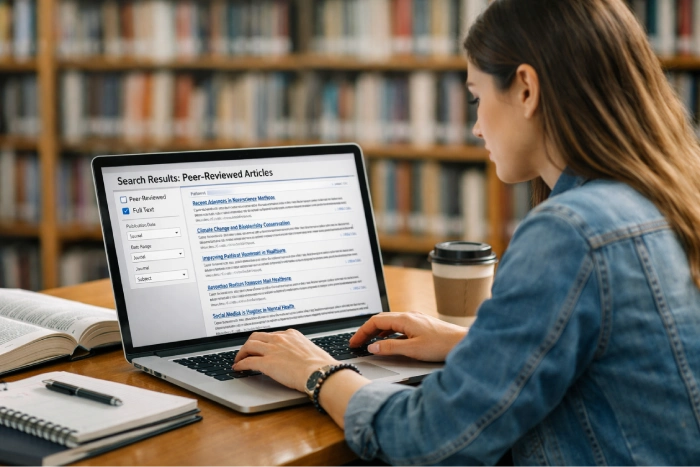
Your university library has databases that are sources of reliable research. Utilize their own peer-reviewed filter, and then check any journal that is not familiar to you before using it for the citation. Google Scholar – the number one search engine students use the first time they search the internet – doesn’t tell you if something is peer-reviewed or not, with all the filters you have to click. Being able to locate the sources and determine the validity of the publications will help eliminate unreliable sources. A careful search strategy also results in a more efficient academic search and better evidence. Don’t rely on the first result that appears in the search; check the journal, article type, and review history of the result. These checks will assist you to choose trustworthy research to use in your university assignment.
Start With Your Library Database, Not a Search Engine
University libraries offer a filter to find peer-reviewed articles in a database. Use Scopus and Web of Science for multidisciplinary research and citations. Biomedicine, psychology and humanities and social sciences are all covered by PubMed/MedLINE, PsycINFO and JSTOR, respectively. Your library might also have subject databases on EBSCO and ProQuest (scholarly publications).
Two practical steps can help you to make your search easier:
- Sign in using your university account: When an article is not available, try to have it sent from another library using interlibrary loan; this is often possible with many Canadian university libraries.
- Discuss with a subject librarian: Librarians will be able to suggest appropriate databases and assess sources. In cases where searches yield few or ambiguous results, their advice can be valuable.
Using the Peer-Reviewed Filter Properly
Database filters are used in several areas such as search pages, search results sidebars, and source-type menus. Read the titles that include words like Peer Reviewed, Scholarly, Academic Journals, or Refereed. Use the filter prior to searching to limit results.
A peer-reviewed filter, however, is more of a beginning than an end. In addition, platforms might not identify some publications, and the classification of a given journal may not indicate whether any item is a research article or an editorial. Never trust the results of the publication without checking the publication first.
Why Google Scholar Can’t Answer This
Google Scholar provides access to a wide variety of scholarly and non-scholarly information. Does not offer an exclusive and peer-reviewed filter, even in advanced search. Journal articles are not the only results that can be included; theses, preprints, working papers, court opinions, and conference slides are also included.
Discover and cite using Google Scholar for chaining and going back to the sources. But double-check the status of the journal in another source before referencing a source. Although Google Scholar can help you find publications, it can’t tell if these publications have been peer-reviewed.
The Five-Step Verification Check
Follow this guide to determine if an article has been a true peer-reviewed process.
- Look At the References. Typically, academic research will have supporting references. Their absence could lead to concerns, but a reference list cannot determine that an article is peer-reviewed.
- Look at the About page of the journal. A credible journal provides information about its editorial policies and reviewers. Check the information regarding reviewers, review process, and publication information.
- Search Ulrichsweb. Find the journal (not the article). It has a Refereed icon, which means that Ulrichsweb has confirmed that the journal is refereed. Access is available in many Canadian university libraries; if not, ask for help from a librarian. Look at the record and don’t believe what the journal is telling you.
- Check indexing. The selection standards adopted by MEDLINE make the MEDLINE records valuable clues in biomedicine. There are other sources that offer more details about journals such as Scopus, Web of Science, and DOAJ, but indexing itself does not mean that a particular article went through the review process.
- Examine submission dates. Check for Received, Revised, and Accepted dates in the article title area or footer. These dates may be a sign of a review cycle, but do not necessarily imply that it is of good quality.
There is no single check that will ensure authenticity. There are some consistent signs that suggest that peer-reviewed articles have been reviewed by editors.
What Isn’t Peer Reviewed, Even in a Peer-Reviewed Journal
A verified journal may publish editorials, Letters, Commentaries, Book Reviews, and News Items without a peer review process. Be sure to check the item type before citing.
Preprints: These are generally unpublished manuscripts uploaded to platforms like arXiv, bioRxiv, medRxiv and SSRN, which have not yet been peer reviewed. Look for and quote a subsequent publication.
A secondary source is an article written after another article, such as a systematic review, which analyzes the results of previously published articles. Peer-review status and source type are two different concepts. Knowledge of this distinction aids in the proper classification of evidence. To find out more, look at this Primary vs Secondary sources guide.
Predatory and Pay-to-Publish Venues
Predatory journals charge publication fees but with minimal or no real review. Look out for the following signs of trouble:
- Widely circulating calls for papers.
- Lacking review policies with little or no review process, or ambiguous policies.
- Members of the editorial board who can not be substantiated by credentials.
- Few or no meaningful revisions, very rapid acceptance.
- A title that is very similar to a published title.
Research submitted and cited should be checked before submission and before naming and citing the journal record on Ulrichsweb, indexing and editorial policy on the journal. A good publication needs to detail its process for conducting reviews and not just say they do. Keep in mind that not everything that is scholarly is peer-reviewed and not everything that is peer-reviewed is scholarly. When composing your assignment make sure you quote and paraphrase their sources effectively and quote their work.
Frequently Asked Questions
Is Google Scholar peer-reviewed?
No. Google Scholar does not have a peer review filter, but has both scholarly and non-scholarly information.
Are all articles in a peer-reviewed journal peer reviewed?
Editorials, letters, commentaries, book reviews, and news items do not go through the peer review process. The journal is verified by Ulrichsweb, but not each article.
How can I tell quickly if an article is peer reviewed?
Review the reference list, look at the journal’s review policy, look for the Refereed icon on Ulrichsweb, and check for Received and Accepted dates.
What do I do if I can’t access an article?
Log in via your institutional access to the database and then use interlibrary loan to get the article. This is a free service for many universities in Canada.
Conclusion
More than just a filter is necessary to find reliable research. Review the journal, article type, and review process. The careful peer review process enhances academic work and aids selection of credible evidence. In case you need further support, then you are able to look for nursing assignment help for assistance on your academic assignments.